Temporal keys
Every Event in pond-ts has exactly one temporal key — the value
that places the event on the timeline. The key is the first column of
a TimeSeries's schema and is what every transform indexes against.
Three shapes are available; which one you pick is a modeling choice that says how the event sits on the timeline.
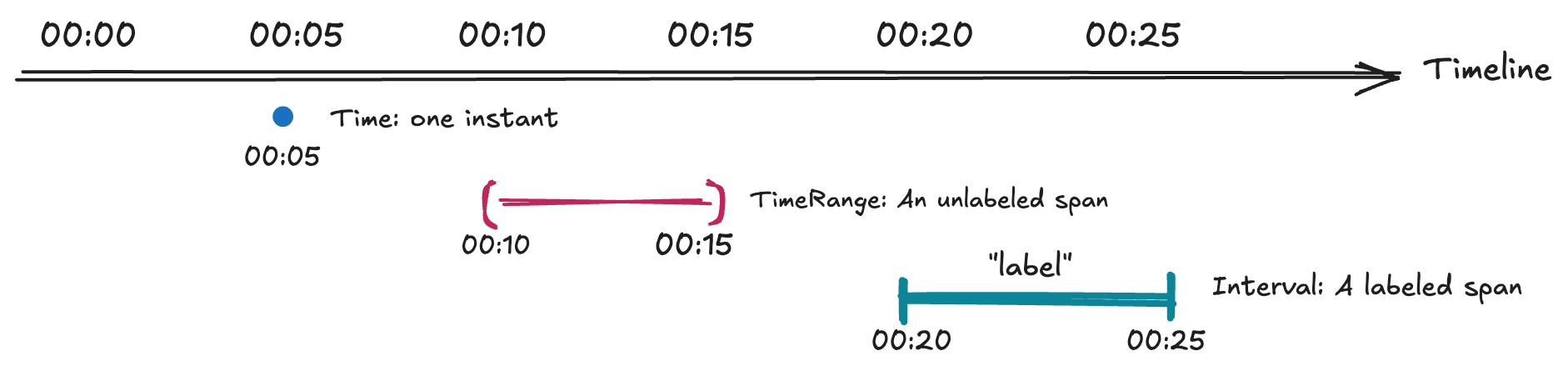
| Key | Shape on the timeline | Use when |
|---|---|---|
Time | One instant | The event is a point measurement |
TimeRange | An unlabeled span between two ts | The event covers a duration but has no bucket identity |
Interval | A labeled span (carries an index) | The event is a bucket produced by aggregate or align |
Time
A single instant on the timeline. The most common temporal key — sensor samples, request timings, individual ticks.
import { Time } from 'pond-ts';

new Time(1735689600000);
new Time(new Date('2025-01-01T00:00:00Z'));
new Time(Date.parse('2025-01-01T00:00:00Z'));
Constructor accepts number | Date. The library does not parse ISO
strings — go through Date.parse(...) or new Date(...) explicitly
when starting from a string. Internal representation is milliseconds
since Unix epoch.
time.begin() and time.end() both return the same number — a Time
has zero extent. This makes Time interchangeable with TimeRange
or Interval for any operator that only cares about the begin or end
of the key.
TimeRange
A span between two timestamps with no bucket identity attached.
import { TimeRange } from 'pond-ts';

new TimeRange({
  start: Date.parse('2025-01-01T00:02:00Z'),
  end:   Date.parse('2025-01-01T00:04:00Z'),
});
Use a TimeRange key when the event covers a duration but doesn't
need to round-trip through a bucket-style identifier — sessions,
request durations, outage windows, scrolling user-interaction frames.
range.begin() and range.end() return the two endpoints. Pond-ts
treats the range as half-open [begin, end) — an event "at" the end
boundary does not belong to this range.
Interval
A labeled span. Identical extent semantics to TimeRange plus an
index value that lets the bucket round-trip through JSON and stay
stable across transforms.
import { Interval } from 'pond-ts';

new Interval({
  value: 1735689600000,
  start: 1735689600000,
  end:   1735689660000,
});
You almost never construct Intervals directly. They are produced by
aggregate(sequence, mapping) and align(sequence, ...) — the
sequence's bucket boundaries become the start / end, and the
bucket's start timestamp becomes the index.
The index is what survives the
series.toJSON() → TimeSeries.fromJSON() round-trip. A bucketed
event keyed by Interval reads back with the same identity it had
before serialization; a TimeRange-keyed event would not.
Picking a key
| If the event is… | Use |
|---|---|
| A reading at one moment | Time |
| A duration-shaped observation (session, span, frame) | TimeRange |
A bucket from a Sequence | Interval |
You declare the key kind in the schema's first column:
const schema = [
  { name: 'time',     kind: 'time' },      // Time-keyed events
  { name: 'duration', kind: 'timeRange' }, // TimeRange-keyed events
  { name: 'bucket',   kind: 'interval' },  // Interval-keyed events
  // ...value columns
] as const;
When you pass rows to new TimeSeries({ rows }), the library
constructs the right key shape from the cell value:
kind: 'time'acceptsnumber | Date | Timekind: 'timeRange'accepts a[start, end]tuple,{ start, end }, orTimeRangekind: 'interval'accepts an[value, start, end]tuple,{ value, start, end }, orInterval
Common operations
All three key shapes share the same minimal interface:
key.begin();  // number — the earliest instant in the key's extent
key.end();    // number — the latest instant in the key's extent
key.toJSON(); // serialise to the schema-typed JSON form
For Time, begin() === end(). Operators that compare events by
position on the timeline (sorting, between, tail, rolling cutoffs)
work on any of the three uniformly through begin() / end().
Where this shows up
- Event construction —
new Event(key, data)accepts any of the three key shapes; the type system threads the schema's first-column kind through to the resultingEvent. - Schema first-column declaration — the
kind: 'time' | 'timeRange' | 'interval'field drives row construction. See Creating series. - Aggregation and alignment —
aggregate(seq, mapping)andalign(seq, …)always produceInterval-keyed events. See Aggregation and Alignment. - Temporal relations — operations like
tail,between,within,overlapping,trimall work in terms ofbegin()/end(). See Temporal relations. - Sequences — a
Sequencedefines a grid of bucket boundaries thataggregateandalignconsume to produceIntervalkeys. See Sequences.